PaliVerse
PaliVerse is a free website for reading the Pāḷi Canon and its commentaries in one consistent English translation. The Pāḷi text sits alongside, and every Pāḷi word in the root texts has a DPD card.
If you want to read the Canon in English and check the Pāḷi word by word, this is worth a look. It needs no account and has no paid features.
PaliVerse has
- the root texts of the Sutta, Vinaya and Abhidhamma Piṭakas in Pāḷi (CST edition) and English
- the commentaries (Aṭṭhakathā) in English, with the sub-commentaries (Ṭīkā) in progress
- five reading layouts: English, Pali, Side by Side, Line by Line and Dictionary View
- links from each paragraph of a root text to the matching paragraph of its commentary
- full-text search of the whole Canon in Pāḷi, with or without diacritics, and in English
- a Sutta Index of 3,574 discourses, searchable by Pāḷi name, abbreviation or PTS number
- Ask PaliVerse, where you ask a question and get an answer with the source passages listed
- a PDF of every text, podcasts on individual discourses, 11 fonts and four themes
- bookmarks, private notes and saved dictionary words for members who log in
Install
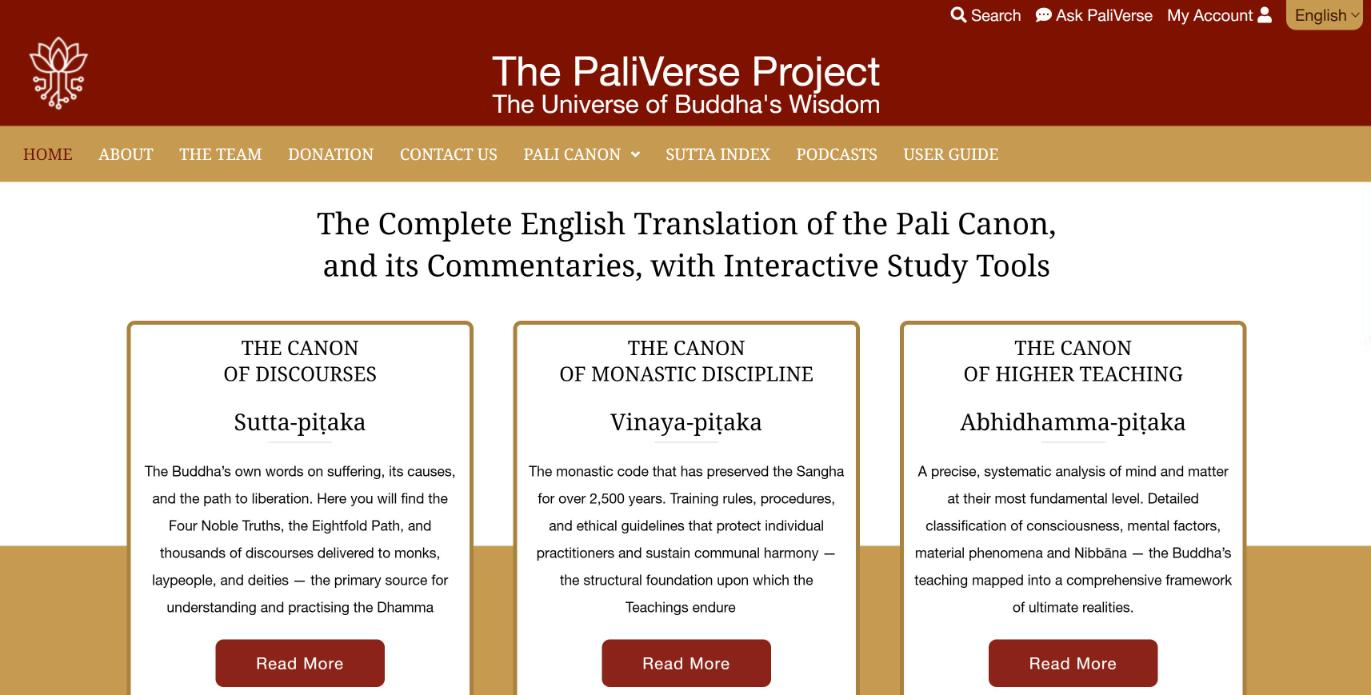
There is nothing to install. Open www.paliverse.org in any modern desktop or mobile browser.
Choose a collection from the Pali Canon menu, or find a discourse in the Sutta Index. The site is in English and Greek.
PaliVerse does not work offline. You can open each text as a PDF with the PDF button, but the dictionary needs an internet connection.
Turn on DPD
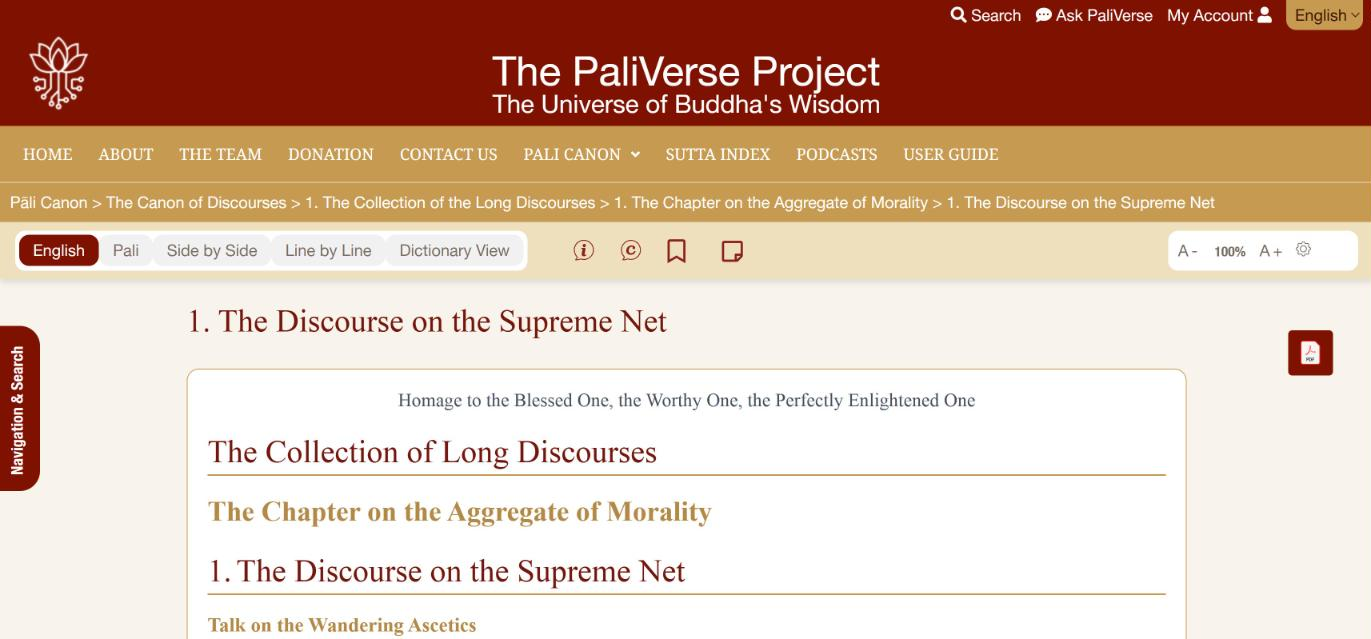
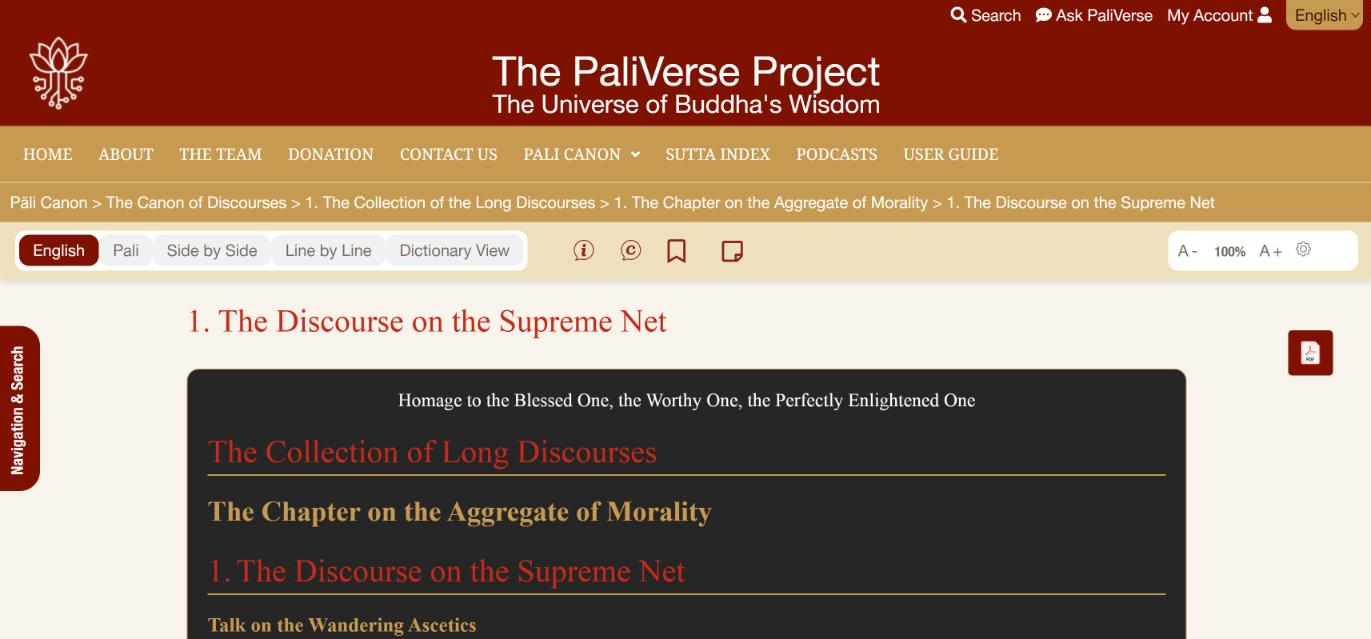
DPD is not on by default. The default layout is English only.
- Open any root text, for example DN 1 from Pali Canon → Sutta-piṭaka.
- Click Dictionary View in the toolbar. On a phone, tap STUDY TOOLS first to show the toolbar.
- The page changes to Pāḷi and English line by line.
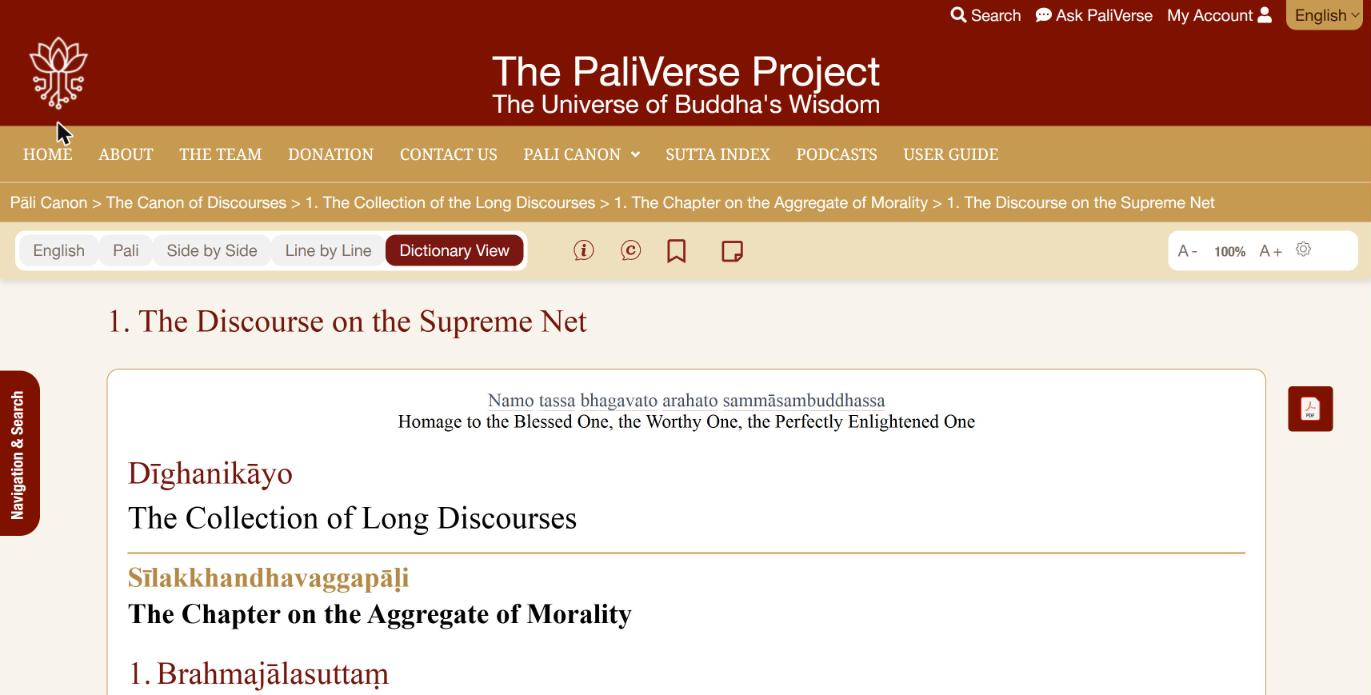
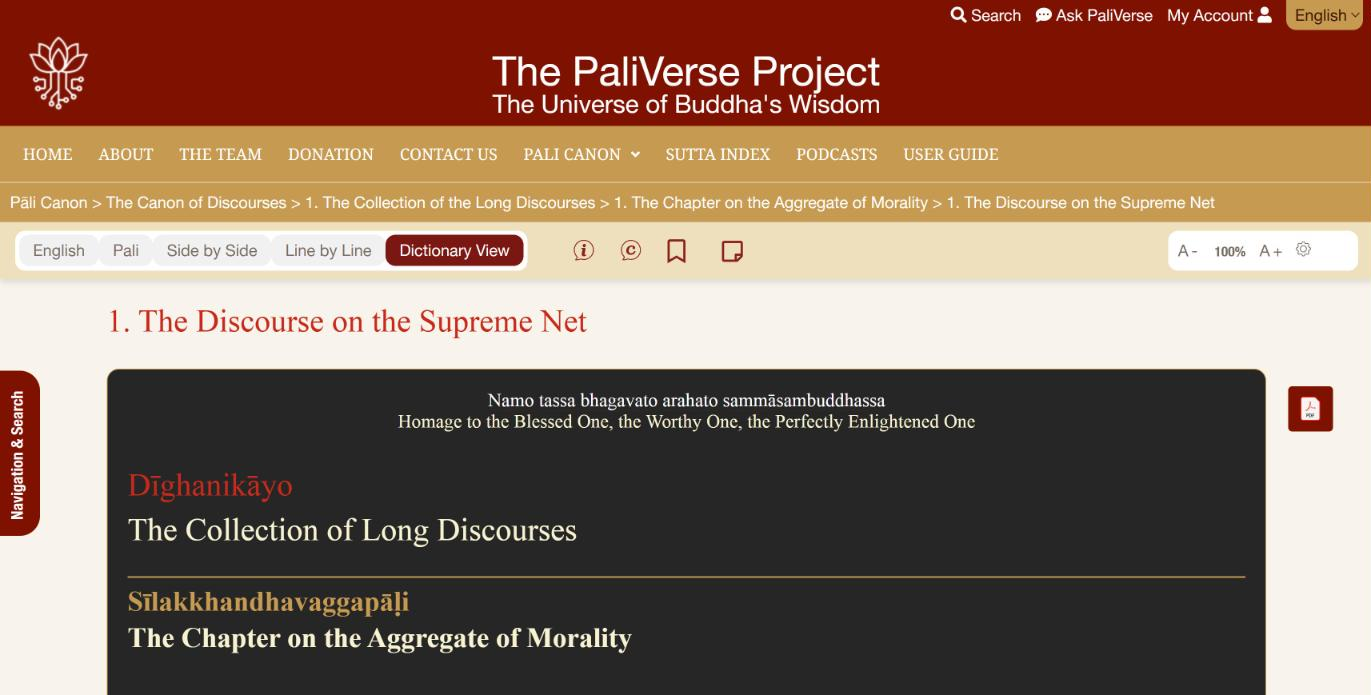
The site remembers your choice, so the next text also opens in Dictionary View. To leave it, click any other layout button.
Dictionary View works on the root texts of all three Piṭakas. It does not yet work on the commentaries and sub-commentaries.
Looking Up a Word
In Dictionary View every Pāḷi word has a faint dotted underline.
- Desktop: hover over a word for a compact card. Click the word to keep the card open with the full entry.
- Phone or tablet: tap the word. The card opens at the bottom of the screen and also shows the English sentence.
- Keyboard: press Tab to reach a word, Enter or Space for the full entry and Esc to close.
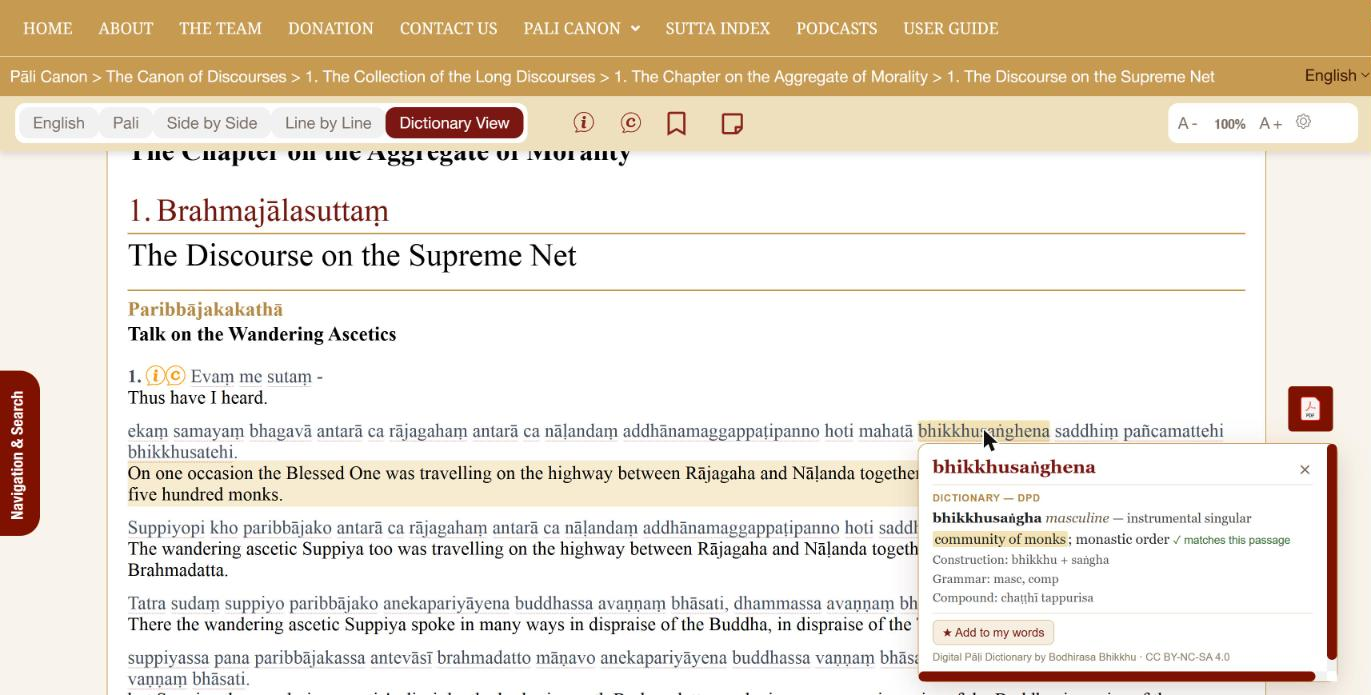
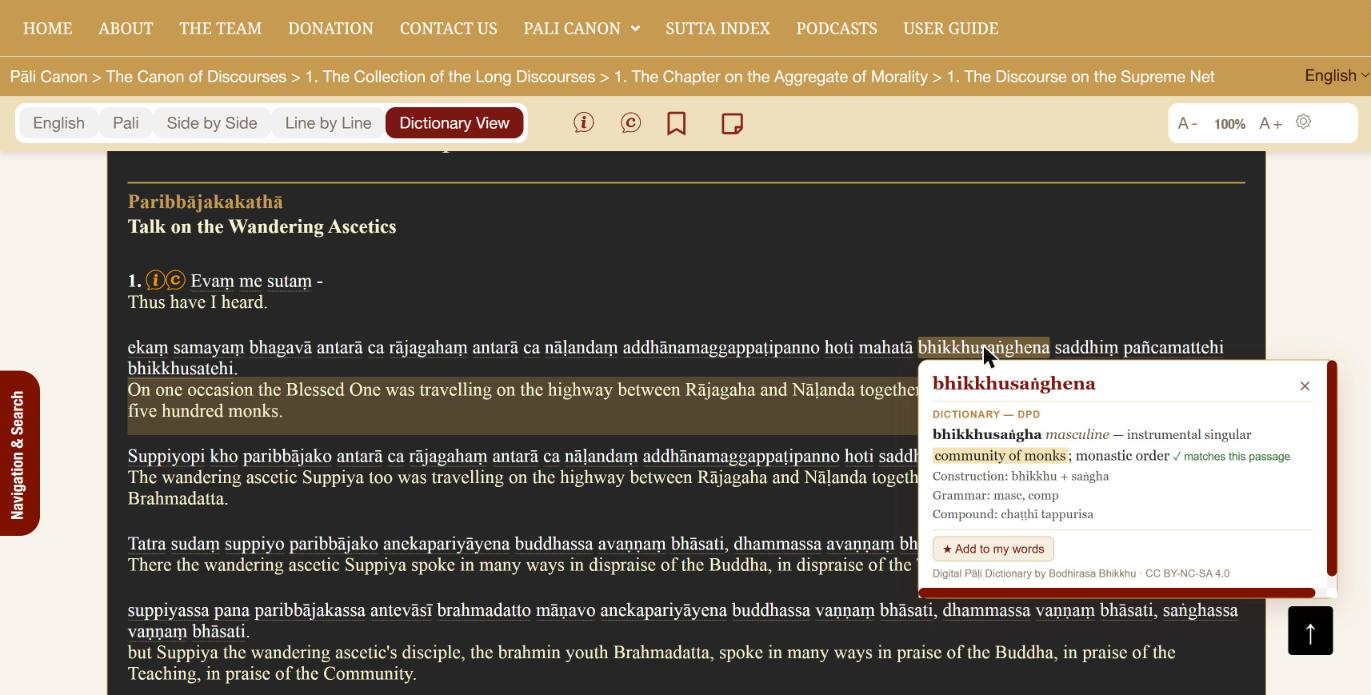
The card shows each possible headword with its grammar and meanings. A word that DPD's deconstructor splits shows the parts, each with its own meaning. The meaning that matches the English translation of that sentence is marked ✓ matches this passage, and that English sentence is highlighted in the text.
Click Full entry to add the literal meaning, construction, grammar notes, root and compound details. Logged-in members can use ★ Add to my words to save a word.
Every card has a credit line that links to dpdict.net.
What Is Not in the Card
PaliVerse uses a light extract of DPD. It has no inflection tables, examples or frequency data. For the full entry, look the word up in DPD itself.
The extract holds only the inflected forms that occur in the PaliVerse texts. It is stored on the PaliVerse server, so no request goes to DPD Online or to any other service.
Get The Latest Version of DPD
You do not download or update anything. The PaliVerse team builds a new extract from a DPD release and installs it on the site. This does not happen at every DPD release.
More Info
The PaliVerse Project is run by the Centre for Study and Practice of Theravada, a non-profit company in Athens, Greece. Michael Xynos founded the project. Venerable Ñāṇadassana Mahāthera guides it and oversees the revision of the English translation.
The English translation is PaliVerse's own, made directly from the Pāḷi. It is made with an AI model inside a translation workflow that includes a glossary of about 6,000 Pāḷi terms and review by human experts. It is still under revision, and corrections are welcome.
Ask PaliVerse covers the discourses and their commentaries. References to the Vinaya and Abhidhamma may be wrong, so check each answer against the sources it lists.
The website is not open source. DPD data in PaliVerse is used under CC BY-NC-SA 4.0.
For help, see the user guide. To report a bug or send a correction, use the contact page or email info@paliverse.org.